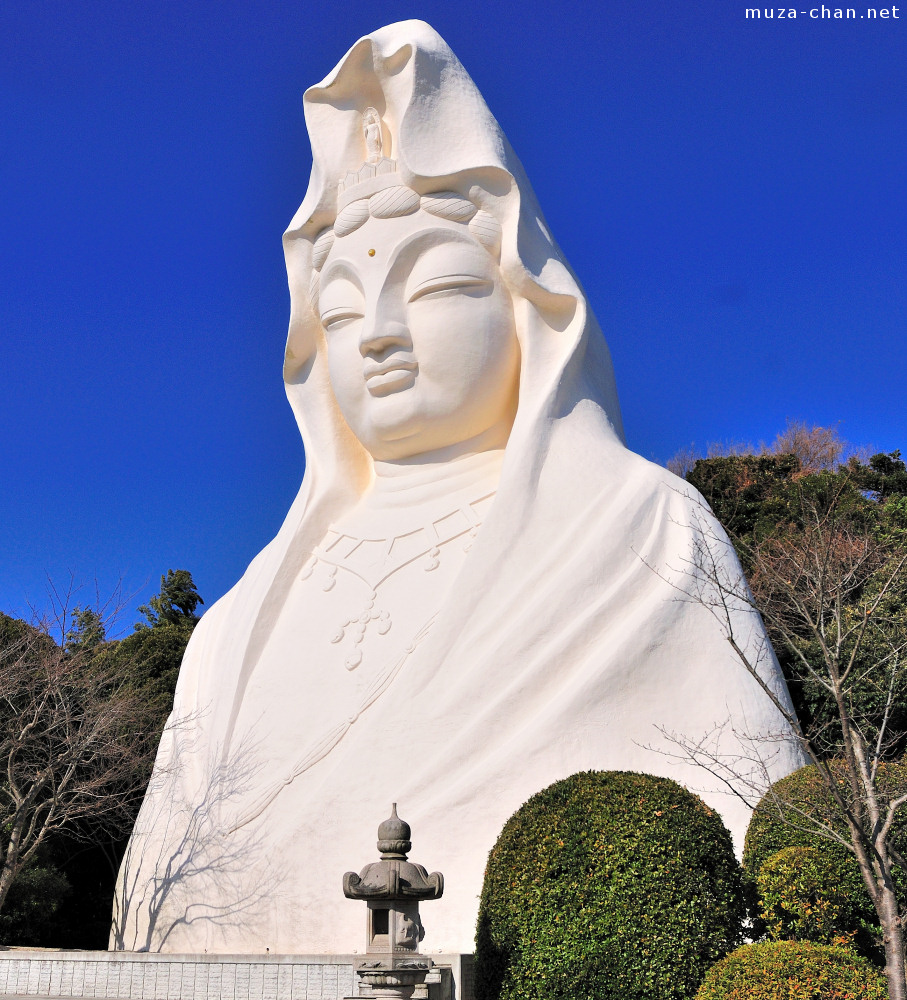
Tags: kannon
Old Japanese Story - Kannon from Hasedera
By Muza-chan on Nov 30, 2009 | In Japan travel | 16 feedbacks »
Inside this hall (Kannon-Do) from the Hasedera Temple in Kamakura, there’s a statue of Kannon, “Bodhisattva of Compassion", that impressed me with its beauty.

This is the biggest wooden statue of Kannon in Japan (9.18 meters tall). It has 11 heads in addition to the normal one, 3 in the front, 3 on the left side and 3 on the right side, one on the top and one on the back.
Each head has a different expression and this signifies that Kannon is listening to the wishes of all types of people… About the head on the back, that can’t be seen, it is said that it is laughing… but the information is unconfirmed.
|
Photography is forbidden inside the hall, but you can see a picture with the statue on the Temple’s official website. The legend tells us how this Kannon statue got to the Hasedera Temple: |
In the year 721, the monk Tokudo Shonin discovered a very large camphor tree in the forest near the Hase village, in the Nara region. Because the trunk was very tall, he decided to make two Kannon statues. The statue made from the lower part was enshrined in the Hasedera Temple from Nara, and the statue made from the upper part, that was larger, was thrown into the sea, with a prayer to reappear where the people would need it.
After 15 years, on July 18th 736, the statue reappeared at the Nagai beach, on the Miura Peninsula, near Kamakura. Those who saw it told that it was glowing in a divine light. The statue was brought in Kamakura and the Hasedera Temple was built to honor it.

The statue remained as it was found until 1342, when it was covered with gold leaf and in 1392 the halo was added.
Unlike other Kannon statues, the Hasedera Kannon holds a Shakujo (Buddhist staff, used usually in Jizo Bosatsu statues) made of tin in its right hand and a vase of lotus flowers in its left hand.
In conclusion, I leave you with some photos with the Kannon-do hall decorations:


Favorite Japan places - Komagatado Temple
By Muza-chan on May 5, 2009 | In Japan travel | 2 feedbacks »
In Asakusa, near Komagata Bashi, there’s a small temple, an architectural jewel, which attracts the eyes of the passersby.
The building was erected recently, in 2003, but it’s built on sacred ground. On this place was built, in the year 628, the first temple dedicated to the Bodhisattva Kannon, the Goddess of Mercy. The statue of the Goddess Kannon, found by two fishermen in the nearby Sumida River, was enshrined in this temple.
The Senso-ji Temple was erected later, in 645, and was also dedicated to Bodhisattva Kannon. Then, the statue was moved and enshrined at Senso-ji.
Locuri favorite în Japonia - Templul Komagatado
În Asakusa, lângă Komagata Bashi, se află o bijuterie arhitectonică, un mic templu care noaptea atrage privirile trecătorilor.
Clădirea este recentă, din 2003, însă este aşezată pe un loc încărcat de spiritualitate. Aici, în anul 628, a fost construit primul altar dedicat zeiţei Kannon, în care a fost pusă statuia zeiţei găsită de doi pescari în râul Sumida, care curge prin apropiere. În anul 645 s-a construit în apropiere templul Senso-ji, dedicat zeiţei Kannon şi statuia a fost mutată acolo.


What to do in Japan? 33 Must See Japanese Scenes
A Japan Photo per Day - Guitar Gallery
J-Links 24 - Cool Japan Articles of the Week
A Japan Photo per Day - Guitar Gallery
J-Links 24 - Cool Japan Articles of the Week
A Japan Photo per Day - Guitar Gallery