Tags: buddha
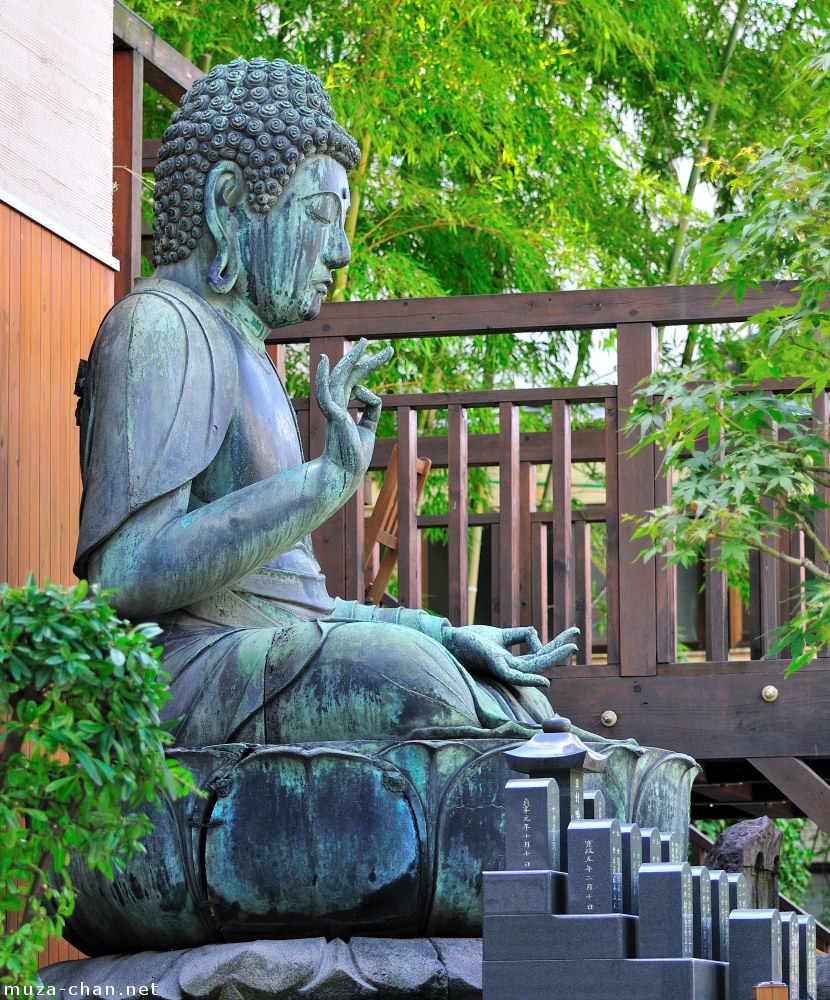
The Great Buddha from Ueno
By Muza-chan on Jan 25, 2010 | In Japan travel | 16 feedbacks »
In the Ueno Park, near the Bells of Time and the Monster Lantern, there’s a small hill known since the Edo Period as Daibutsu Yama (the Great Buddha Hill).

The first Daibutsu (Great Buddha) was built on this place in 1631 by the lord Hori Naoyori from Murakami, Niigata prefecture. It was a 2.8 meters statue representing a sitting Buddha. This statue was destroyed only 16 years after construction, by a powerful earthquake.
The second Daibutsu, built on the same place, was erected by a monk named Jyoun with money collected from donations and was also a seated Buddha, 3.6 meters tall.
This statue lasted until the Great Kanto Earthquake in 1923, when it was severely damaged and its face fell off.
Fortunately, the face of Daibutsu was preserved at the Kanei-ji Temple, and we can see it today enshrined on this monument built in 1967.

The body and the pedestal were lost forever, because during the Second World War a law called the Metal Acquisition Law ordered the delivery of all metallic goods for weapons production. Who knows how many precious objects of art disappeared during those days in the smelters…
Five years later, in 1972, the Ueno Tourist Association also built a pagoda enshrining three Buddhist images of Yakushi Nyorai, Gakko Bosatsu and Nikko Bosatsu.


A Technical Look at the Great Buddha of Kamakura
By Muza-chan on Dec 9, 2009 | In Did you know... | 25 feedbacks »
| Follow up from: A Spiritual Look at the Great Buddha from Kamakura |
The Great Buddha from Kamakura (Daibutsu) was cast in 1252, with money raised from donations by the priest Joko and was sculpted by Ono-Goroemon and Tanji-Hisatomo.

Click on photo for higher resolution:
The statue is made from bronze, is 13.35 meters tall and weights approx. 121 tons. The thickness of the bronze varies between 3 and 12 centimeters and because of its huge size, the statue was made from 30 shaped parts welded together, with internal armature. The colossal statue proved to be extremely resistant.
In 1335, the wooden temple where the statue was housed was destroyed by a powerful storm, but Daibutsu was undamaged. Later, in 1498, the entire area was affected by an earthquake followed by a tsunami and again the housing building was destroyed but the statue was safe.
In 1923, after the Great Kanto Earthquake, the base of the statue was damaged, but the bronze Daibutsu remained in good condition.

The interior of the statue can be visited and the construction technique can be clearly seen. You can see the entry to the lower right corner of the photo:

A spiral staircase climbs to a small room located right under the head. You can see in this photo the two small windows illuminating the inside of the statue:

Inside, a detailed diagram explains the amazingly sophisticated technique, called Ikarakuri, used by the builders of the statue to connect together the 30 large bronze pieces.

In 1960, repair and consolidation works started, employing modern materials and techniques. Layers of plastic were applied to the neck to reinforce the head…


… and between the pedestal and the statue was inserted a stainless steel plate, to allow the statue to move freely on the base and to avoid shocks during earthquakes.
With all these improvements, the Kamakura Daibutsu will certainly last for many more centuries to come…


12 Sakura Manhole Covers
A Japan Photo per Day - Imperial Palace, Otemon Gate
12 Sakura Manhole Covers